Across cultures, there’s always that one food that feels communal. The kind of meal that brings people together, smells better than it looks at first glance, and somehow tastes even better when eaten standing up, outside, or among friends. In the United States, that food is barbecue. In Greece, without much debate, it’s souvlaki.
But is souvlaki really the Greek equivalent of American BBQ? From a Greek food perspective, the answer is yes—just not in the way you might expect.
Different Traditions, Same Soul
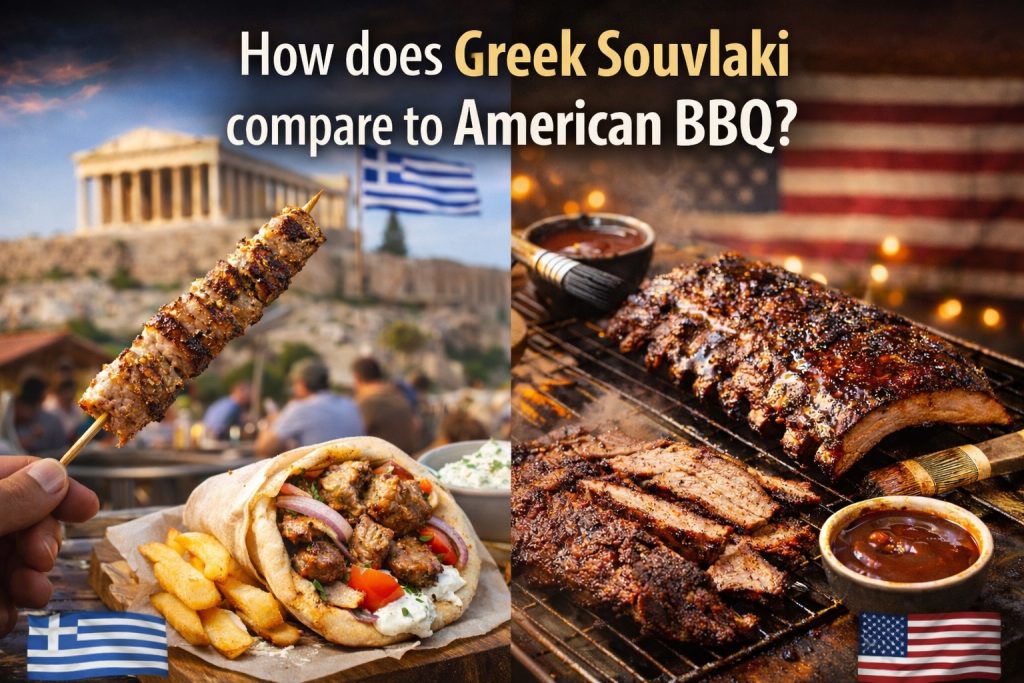
American BBQ is a ritual. It’s slow, deliberate, and often regional—Texas brisket, Carolina pulled pork, Memphis ribs. It’s about smoke, patience, and technique passed down like family heirlooms.
Greek souvlaki is faster, simpler, and more spontaneous. Small pieces of meat—usually pork, chicken, or lamb—are skewered, seasoned, and grilled over open flames. No hours-long smoking process. No elaborate rubs. Just fire, meat, salt, oregano, and maybe a squeeze of lemon.
Different methods, yes. But the heart of the experience is the same: cooking meat over fire, meant to be shared.
The Grill Is the Great Equalizer
In Greece, the grill isn’t reserved for weekends or special occasions. It’s part of everyday life. Souvlaki stands line the streets, filling the air with smoke and anticipation. Backyard grills come alive on Sundays. Easter lambs turn slowly over open flames. The act of grilling is social, casual, and deeply ingrained.
That’s where the comparison to American BBQ becomes clear. In both cultures, grilling isn’t just about food—it’s about gathering. Friends show up uninvited. Conversations stretch longer than planned. Someone always insists they know the “right way” to grill.
Simplicity vs. Excess—And Why That Matters
American BBQ often celebrates abundance. Big cuts of meat. Heavy sauces. Plates that require commitment. Greek souvlaki, on the other hand, leans into restraint. Smaller portions, minimal seasoning, and a focus on the quality of the meat itself.
But this simplicity doesn’t make souvlaki less meaningful. In fact, it’s what makes it powerful. Like BBQ, souvlaki is accessible. It’s street food and home food. It’s eaten by construction workers, office workers, students, and families alike. No pretense. No hierarchy.
Sauce or No Sauce? A Cultural Divide
One of the biggest differences between American BBQ and Greek souvlaki is sauce. BBQ sauce is iconic in the U.S.—sweet, smoky, tangy, and often debated. In Greece, sauce takes a backseat. Tzatziki may accompany souvlaki, but it never dominates. The meat is the star.
From a Greek point of view, too much sauce hides mistakes. If the meat needs covering, something went wrong. This philosophy mirrors traditional Greek cooking as a whole: fewer ingredients, better execution.
Souvlaki as Identity, Not Trend
Just as BBQ is fiercely defended across American regions, souvlaki is deeply personal to Greeks. Everyone has a favorite spot. Everyone believes theirs is the best. Arguments over pita vs. no pita, pork vs. chicken, Athens vs. Thessaloniki can get surprisingly intense.
That passion is another reason souvlaki earns its BBQ comparison. It’s not just food—it’s identity.
So, Is Souvlaki Greek BBQ?
Not technically. Not stylistically. Not even temporally.
But spiritually? Absolutely.
Souvlaki and American BBQ are cousins, not twins. Both are born from fire, tradition, and community. Both thrive outside, among people, without ceremony. And both remind us that the simplest foods often carry the deepest meaning.
From a Greek food perspective, souvlaki isn’t trying to be American BBQ. It doesn’t need to be. It already fills the same role—bringing people together, one skewer at a time.