Archestratus: The Father of Gastronomy
Archestratus, an ancient Greek poet and philosopher from Gela or Syracuse in Sicily, is widely regarded as the father of gastronomy. Living in the mid-4th century BC, he authored the humorous didactic poem Hedypatheia (“Life of Luxury”), which offered gastronomic guidance on where to find the best food across the Mediterranean and unveiled the secrets of ancient Greek cuisine.
Although the poem itself has been lost, 62 fragments—roughly 300 lines—have survived. By 228 AD, the writer Athenaeus still had access to Hedypatheia, quoting it in his work Philosophers at Dinner. These fragments are the source of Archestratus’ enduring culinary wisdom.
Archestratus was the first to treat cooking as an art. He emphasized the consumption of fish, pulses, and wine—ingredients highly valued in ancient Greece and still central to a healthy modern Greek diet. The modern term “gastronomy” (literally “Rules of the Stomach”) is believed to originate from Archestratus’ writings, known to later readers as Gastronomia.
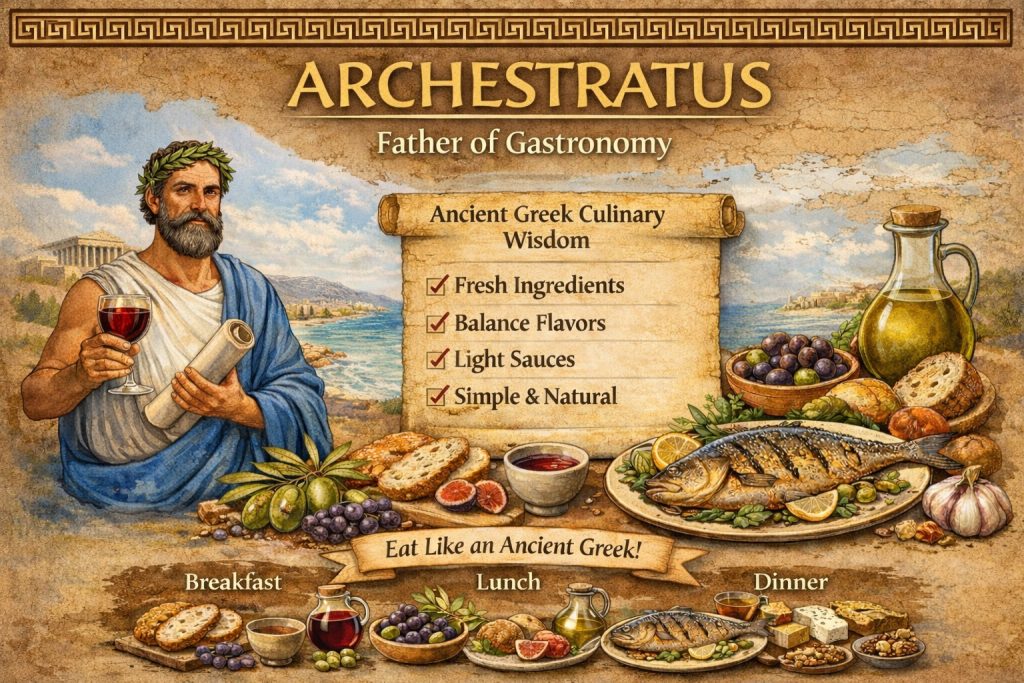
Greek archaeologist Georgia Karamitrou-Mentesidi highlights five timeless rules from Archestratus for cooking and eating:
- Use fresh, high-quality ingredients.
- Combine flavors harmoniously.
- Avoid overly hot sauces and spices.
- Prefer lighter sauces to let the food shine.
- Season sparingly to preserve natural flavors.
Archestratus himself was likely not a professional cook, as cooks of his era were usually not literate, let alone capable of composing poetry. Yet his deep knowledge suggests he was a passionate foodie who closely observed and interacted with his cooks and servants.
Culinary Philosophy and Advice
Archestratus advocated simplicity: fish should be cooked with minimal seasoning, reserving stronger flavors for lower-quality catches. He famously criticized the Syracusans for adding cheese to fish, considering it a culinary misstep.
A glimpse of his advice reveals his precise, discerning taste:
“But I say to hell with saperde, a Pontic dish, and those who praise it. Few people know which food is wretched and which is excellent. Seek a mackerel on the third day, before it goes into salt water, as a piece of freshly cured, half-salted fish.
And if you come to Byzantion, I urge you to eat peak-season tuna—it is soft and superb.
Do not let anyone near you when you bake sea wolf—neither Syracusan nor Italiote—because they ruin it with cheese, vinegar, and silphion brine.
The finest barley comes from the sea-washed fields of Eresus in Lesbos, whiter than airborne snow. If the gods eat barley, this is where Hermes shops.
In Ambracia, if you see boar-fish, buy it, even at its weight in gold—this fish is the flower of nectar.”
Gastronomy in Ancient Greece
Ancient Greeks followed a structured daily eating routine:
- Akratisma: a simple breakfast of bread dipped in wine.
- Ariston: a light meal around noon or early evening, typically bread, olive oil, fruit, and red wine.
- Esperisma: a pre-dinner snack.
- Deipnon: the main dinner, a feast to conclude the day.
Meals were simple yet nutritious. Cereals like wheat and barley were staples, often complemented by onions, olives, herbs, fruits, garlic, cheese, and fresh or salted fish. Legumes such as broad beans and lentils were also common. Meat was rare and considered somewhat barbaric.
Desserts included fresh or dried fruits, nuts, and honey, while wine—always diluted with water—was the beverage of choice, enabling conversation without intoxication.
Through his poetry, Archestratus captured the essence of Greek gastronomy: a celebration of fresh ingredients, balanced flavors, and mindful enjoyment—a legacy that continues to influence the culinary world today.
Source: greekreporter Edited By Bernie